
Why Are the Trades Worth Taking Seriously Right Now?
Australia’s construction, infrastructure, and essential services industries are under pressure. Jobs and Skills Australia has flagged electricians, plumbers, carpenters, and HVAC technicians as persistently in-demand roles. That demand is not slowing down.
So the question is not whether there are jobs. There clearly are.
The question is whether you are qualified to fill them.
Vocational Course Outcomes
Most trades require a Certificate III or Certificate IV under the Australian Qualifications Framework (AQF). These are nationally recognised and the standard entry point for licensed trade work.
These courses are nationally recognised. A Certificate III in Electrotechnology completed in Queensland is accepted by employers in Western Australia, Victoria, or anywhere else across the country.
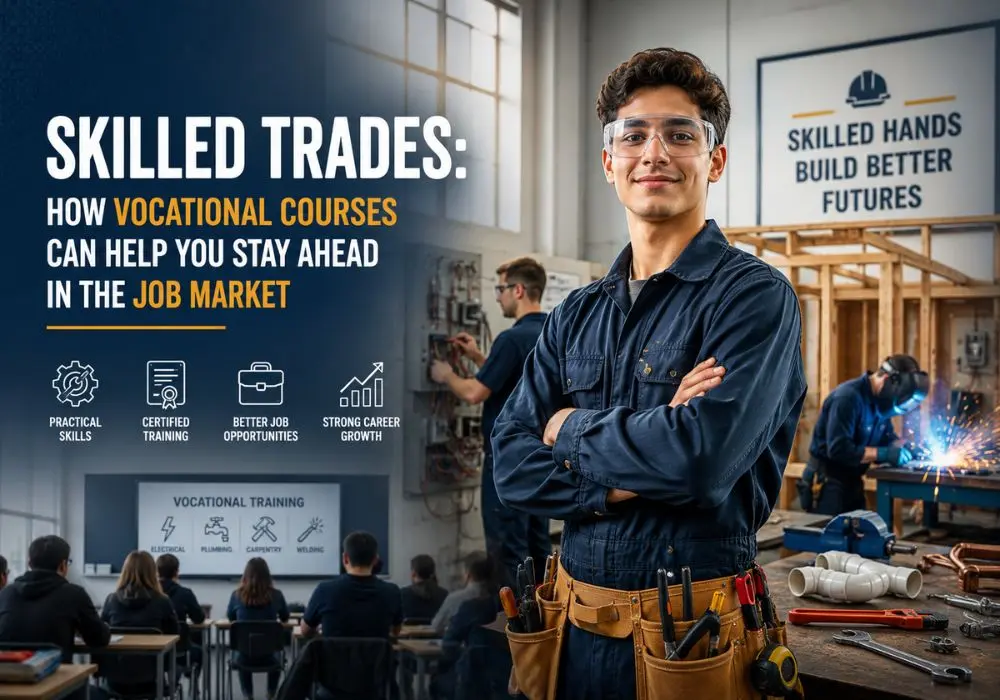
Most trade qualifications combine classroom theory with hands-on practical training. You are not spending three years sitting in lectures. You are learning on tools, in workshops, and often on real job sites through apprenticeships or work placements.
Common vocational trade qualifications include:
- Certificate III in Electrotechnology Electrician
- Certificate III in Plumbing
- Certificate III in Carpentry
- Certificate IV in Building and Construction
- Certificate II in Automotive Servicing Technology
- Certificate III in Refrigeration and Air Conditioning
Each of these leads directly to licensable, employable work.
| We recommend: The course code matters more than most people realise. A common and costly mistake is enrolling in a qualification without confirming that its specific unit code is accepted as the prerequisite for your state’s trade licence. Licensing bodies update their requirements, and older course codes are sometimes no longer accepted for new licence applications. We always advise confirming this with the relevant state authority before you sign any enrolment form. |
How Long Does It Take, and What Does It Cost?
A full trade apprenticeship in Australia typically runs three to four years. But not every vocational course requires that commitment.
Short courses, skill sets, and pre-apprenticeship programs can be completed in weeks or months. These are useful if you want to test a trade before committing fully, or if you are updating a specific skill rather than starting from scratch.
| Qualification | Typical Duration |
| Pre-apprenticeship program | 6 to 12 weeks |
| Certificate II (introductory) | 6 to 12 months |
| Certificate III (trade-level) | 3 to 4 years (apprenticeship pathway) |
| Certificate IV (supervisory) | 6 to 18 months |
Cost varies. Under the Australian Government’s Fee-Free TAFE initiative, many high-demand trade qualifications are fully subsidised for eligible students. In Victoria, Fee-Free TAFE covers plumbing, electrical, and construction courses. Queensland’s Skills Strategy links funding directly to its Priority Skills List, which is updated regularly.
It is worth checking your state’s training authority directly, because eligibility rules and course lists change.
| We recommend: Know what financial support you are entitled to before you rule out an apprenticeship on cost grounds. Many prospective apprentices do not realise they can access the Australian Apprentice Support Loan, which now carries an interest-free balance of up to approximately $26,000 for priority trades. From July 2025, the Key Apprenticeship Program also provides up to $10,000 in incentive payments for housing construction apprentices over the life of their training. Queensland also offers its own support through the Small Business Apprenticeship Pilot Program, which provides wage subsidies to eligible small businesses employing construction apprentices. |
The Licensing Side for Vocational Courses
Licensing requirements vary by state and territory.
Electricians, plumbers, and gas fitters must hold a state-issued licence to work independently in Australia. In New South Wales, electrical work requires a licence from NSW Fair Trading. In Victoria, electrical work is licensed through Energy Safe Victoria. Each has its own application process, fees, and competency requirements.
It is a structure that protects both workers and the public. But you need to factor licensing into your planning timeline.
| We recommend: Always check the licensing requirements for the state where you plan to work, not just where you are studying. This is a common issue. Completing a qualification in one state and relocating, only to find you need extra documentation or a supplementary assessment in the destination state.If you are planning to move interstate after finishing your course, contact the destination state’s licensing body before you even enrol. It takes one phone call and can save you months of delays on the other side. |
The Real Demand Right Now
Based on data from Jobs and Skills Australia and industry bodies like the Housing Industry Association, these are the trades with the strongest national shortfall:
- Electricians: Shortage across all states, particularly in renewable energy and residential construction. Estimates suggest 32,000 to 42,000 additional electricians are needed by 2030.
- Plumbers: High demand driven by infrastructure and housing targets.
- Carpenters and joiners: Ongoing need linked to the residential building sector. Around 22,000 additional carpenters are needed to meet current housing targets alone.
- Refrigeration and air conditioning mechanics: Growing demand tied to commercial fitouts and climate adaptation.
- Automotive technicians: Particularly those with electric vehicle skills.
The completion rate for apprentices sits at around 55%, according to the most recent NCVER data. That means nearly half of all people who start a trade qualification do not finish. For trade completers, more than 95% find employment after finishing.
| We recommend: If you are in automotive or considering it, EV certification is no longer optional. We strongly advise adding a Certificate III in Automotive Electric Vehicle Technology to your trade pathway now, before 2027. The window to get ahead of the curve is closing fast. Traditional combustion-engine skills are not disappearing overnight, but the job market is already rewarding technicians who can work across both. The providers offering this qualification remain limited, which itself is an opportunity for anyone willing to seek it out. |
What to Look For When Choosing a Course Provider
Not every registered training organisation (RTO) is the same.
Reports from ASQA and industry bodies have consistently flagged substandard training practices at some providers, including inadequate facilities and a disconnect between what is taught and what employers actually need. In 2023, employer satisfaction with VET apprenticeships had dropped by 8 percentage points since 2015, according to the Productivity Commission.
When assessing a provider, check:
- RTO registration: All legitimate providers must be registered on the ASQA register at training.gov.au.
- Industry connections: Good providers have ties to local employers and can help place students in work placements or apprenticeships.
- Trainer experience: Trainers should have recent, practical industry experience, not just a teaching background.
- Facility quality: Trade training requires proper workshops and equipment.
| We recommend: Visit the workshop in person before you commit to anything. Ask trainers directly when they last worked on a real job site. We have seen students invest years of time and money at providers with outdated equipment and trainers whose last hands-on experience was a decade ago. A short site visit tells you more than any course brochure. If a provider is reluctant to let you see the training space before you enrol, treat that as a warning sign. |
The Qualification Is the Starting Line
The AQF is designed to be stackable. Each qualification you complete can build toward a diploma, an advanced trade licence, or business ownership. The tradespeople who earn the most and stay in demand longest are the ones who keep adding to their skills. That might mean moving from Certificate III to Certificate IV, picking up additional licences, or cross-training in a related area.
If you are weighing up whether a vocational trade course is worth your time, check whether the job outcome you want requires that specific qualification in your specific state, and whether you have a plan for what comes after.
Get those two things right, and the rest follows.
| We recommend: Before you choose a trade, cross-reference the Jobs and Skills Australia Skills Priority List. Many people pick a trade based on what seems popular or what a mate does. That list tells you which occupations are in genuine national shortage right now, not just which trades sound appealing. We have seen people spend three years training for a qualification only to find their chosen field is oversupplied in their state. A few minutes of research before you enrol saves years of frustration. |
Frequently Asked Questions
Is it too late to start a trade apprenticeship if I’m in my 30s or 40s?
There is no upper age limit for an Australian Apprenticeship. Many employers actively prefer mature-age apprentices for their reliability and work ethic, and government support payments apply regardless of age.
Can I get credit for trade experience I’ve already built up without a formal qualification?
Yes. Recognition of Prior Learning (RPL) allows you to have existing skills assessed against the relevant AQF qualification, which can significantly shorten your course duration and reduce what you need to complete formally.
Do I need to find an employer before I can start an apprenticeship, or does the training provider arrange that?
You generally need an employer willing to take you on before a training contract can be formalised. If finding one is the sticking point, an Apprenticeship Network Provider (ANP) can match you with host employers at no cost to you.