
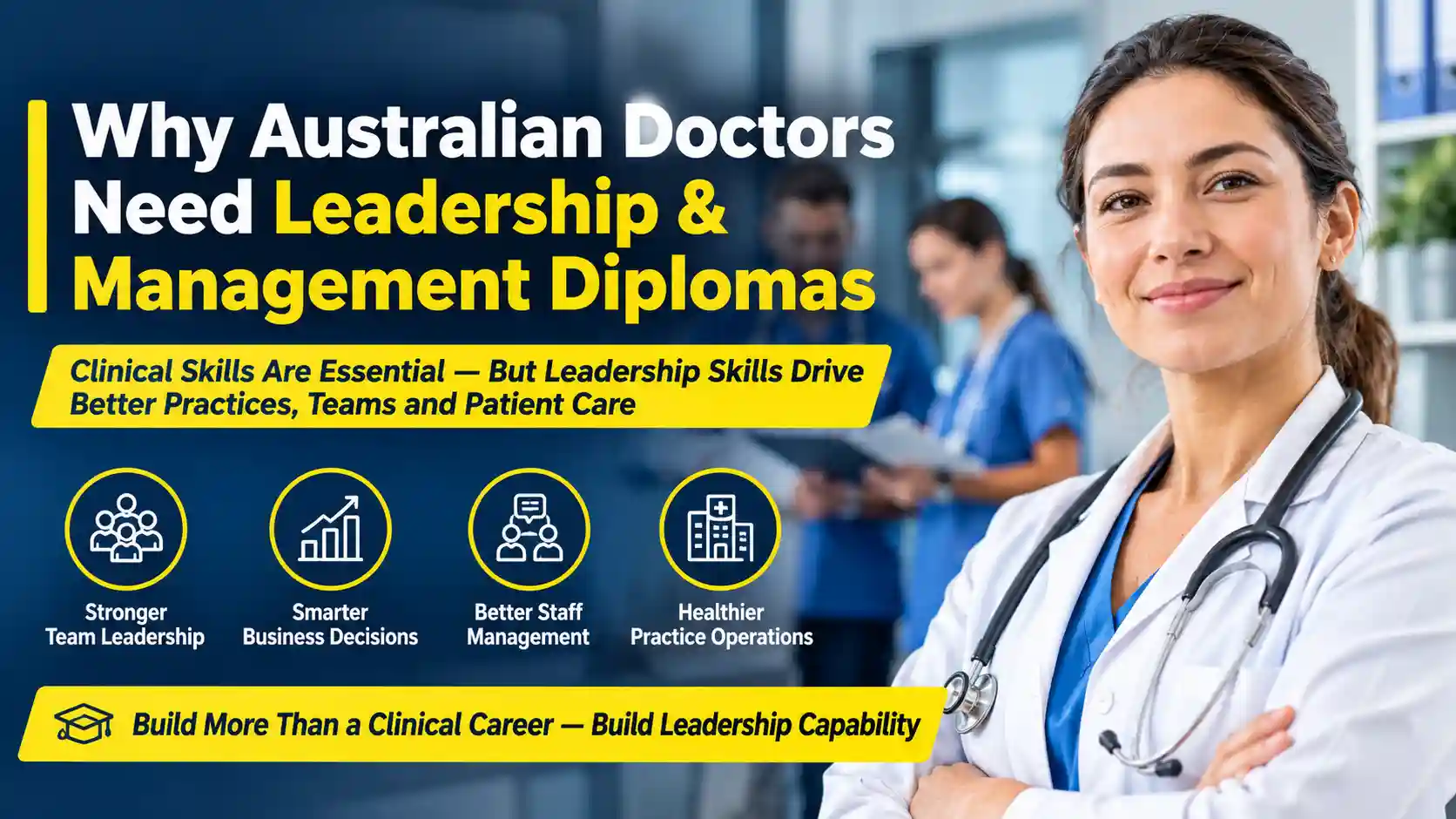
Medical school teaches you how to treat patients. It rarely teaches you how to run a team, manage a budget, or lead a department. That gap becomes obvious the moment a doctor takes on a practice, a clinical unit, or any role with staff reporting to them.
This article looks at the real career impact of Leadership and Management Diplomas for Australian doctors, who actually needs one, how it compares to the specialist medical administration pathway through RACMA, and what a diploma genuinely changes in day-to-day practice.
Why Clinical Training Does Not Prepare Doctors for Management
Becoming a registered doctor in Australia takes years of clinical training, supervised practice, and specialty college assessment. None of that curriculum is built around budgeting, staff performance management, or organisational strategy.
The Royal Australian College of General Practitioners has openly recognised this gap. It developed a general practice business toolkit specifically because so many GPs step into practice ownership with strong clinical skills and almost no formal training in running a business. The toolkit covers six modules, from establishing and marketing a practice through to managing its finances and staff, and the College notes it is just as relevant for hospital clinicians moving into practice leadership for the first time.
Most doctors who take on a leadership role, opening their own clinic, becoming a clinical director, or supervising a team of junior doctors, do it without ever having studied management formally. The clinical degree simply was not built to cover it.
What a Leadership and Management Diploma Actually Covers
A nationally recognised qualification such as the BSB50420 Diploma of Leadership and Management is not a medical qualification. It is a business and leadership qualification that prepares students to apply judgement in planning, organising, and monitoring both their own workload and the work of others.
For a doctor, that translates into the parts of the job clinical training never covered: rostering staff, reading a clinic’s financial position, having a genuine underperformance conversation, and leading a team through change instead of learning it all by trial and error. The qualification builds these skills around communication, problem-solving, and synthesising information under pressure, which is a fair description of what running a busy practice or a hospital department actually feels like on a hard day.
GPs and Practice Ownership: Where the Gap Is Widest
The clearest case for a leadership diploma is general practice ownership. A GP who buys into or starts a practice suddenly becomes an employer, a landlord in many cases, and the person accountable for the business’s financial survival, on top of continuing to see patients.
The Australian Association of Practice Management exists precisely because this skill gap is so common across the sector. Formal qualifications that build genuine management capability, rather than leaving practice principals to learn entirely on the job, are increasingly recognised by professional bodies in the sector as valuable continuing development for doctors in these roles.
A doctor who understands budgeting, staff rostering, and change management before opening a practice avoids some of the most common and costly early mistakes: understaffing during peak periods, mismanaging cash flow, or losing good staff because a performance issue was never properly addressed.
Doctors Moving Into Hospital and Health Service Leadership
For doctors moving into administrative roles within a hospital or health service, clinical director, department head, or medical advisor, the RACMA offers the specialist pathway. RACMA Fellowship is a three-year program requiring candidates to hold at least three years of postgraduate clinical experience and typically involves a master’s degree in Health Management or Public Health. Fellows go on to become Chief Medical Officers, Directors of Medical Services, and senior health system executives.
RACMA also runs shorter, non-specialist programs for clinicians who want leadership skills without committing to the full Fellowship. Its Management for Clinicians program develops foundation management and leadership capability, while Leadership for Clinicians is a Board-approved pathway that can lead to Associate Fellowship for doctors who complete it.
A nationally recognised VET diploma sits below both of these RACMA pathways in formal medical recognition, but it is faster to complete and more accessible to a doctor early in their leadership thinking, since it does not require enrolment in a specialist college. For a doctor unsure whether medical administration is a long-term specialty direction, a leadership diploma is a lower-commitment way to test and build genuine management capability first.
Career Impact: What Actually Changes After Completing a Diploma
The practical impact of a Leadership and Management Diploma shows up in a few consistent ways for doctors.
Staff retention improves. Doctors who have studied performance management, conflict resolution, and team communication tend to handle staffing issues before they escalate into resignations, rather than reacting after a valued nurse or receptionist has already decided to leave.
Financial decision-making becomes more structured. Budgeting and risk management modules give doctors a framework for pricing decisions, staffing levels, and equipment investment, rather than relying on gut feeling or an accountant’s advice alone.
Career options widen. A formal leadership qualification on a CV signals genuine management capability to health services, private hospital groups, and medical practice networks considering a doctor for a director or head-of-department role, even outside the RACMA specialist pathway.
Delegation improves. Many clinically trained doctors default to doing everything themselves because that is how clinical training works. Structured leadership study explicitly addresses delegation and workload planning, one of the fastest ways to reduce burnout in a management role.
Who Actually Needs This Qualification
Not every doctor needs formal leadership training. It tends to matter most for:
- GPs planning to buy into or start a practice, who want formal business and staff management skills before taking on full ownership responsibility.
- Hospital doctors moving into a supervisory or department leadership role, who want a faster, lower-commitment leadership qualification before deciding whether to pursue full RACMA candidacy.
- Doctors already managing a team informally, who want to formalise skills picked up ad hoc and close genuine gaps, such as budgeting or performance management, that clinical training never covered.
- Locums and registrars considering a longer-term move into practice ownership or administration, who want a head start before committing to a specific pathway.
Frequently Asked Questions
Is a Leadership and Management Diploma the same as RACMA Fellowship?
No. RACMA Fellowship is a three-year specialist medical college pathway that leads to recognised Specialist Registration in Medical Administration, typically requiring a master’s degree and at least three years of postgraduate clinical experience. A nationally recognised diploma such as BSB50420 is a general business and leadership qualification, open to any professional, and can be completed in around a year. It is a practical, faster complement to clinical training, not a substitute for RACMA if the goal is to become a Specialist Medical Administrator.
Do I need a leadership qualification to become a GP practice owner in Australia?
There is no legal requirement to hold a management qualification before owning a general practice. However, the RACGP’s own general practice business toolkit exists because so many practice owners take on the role without formal training and then learn the hard way. A structured qualification reduces that learning curve considerably.
Can a doctor study a Leadership and Management Diploma part time alongside clinical work?
Yes, in most cases. Nationally recognised diplomas in this area are commonly delivered in blended or flexible formats designed for working professionals, which suits a doctor balancing clinical shifts with study. Course structure and contact hours vary by provider, so confirm delivery format and scheduling with the relevant registered training organisation before enrolling.
Does a Leadership and Management Diploma count toward continuing professional development for doctors?
Recognition varies by professional body and specialty college. Some practice management-focused qualifications are recognised for continuing professional development points by industry bodies such as the Australian Association of Practice Management. Doctors should confirm CPD recognition directly with their relevant college, since requirements differ between GPs, specialists, and RACMA candidates.
What is the fastest way for a doctor to build management skills without a full postgraduate commitment?
A nationally recognised VET-level Leadership and Management Diploma is generally the fastest formal option, typically completed in around a year. It sits below a master’s degree or RACMA Fellowship in level of specialist medical recognition, but delivers genuine, practical management skills far faster and with a much lower time and cost commitment.